


New Year’s Resolutions are rubbish.
Let me revise that: New Year’s Resolutions are a beautiful concept on paper, but anyone who’s tried to commit to one knows that for most of the population, they simply don’t work. Popular studies show that around half of the Western World makes some form of the New Year’s Resolution, but only 25% of individuals are still committed after the first month. Worse still, only around 10% of goals find fulfillment.
In response, Columbia University’s Donald Edmondson suggests a revision to how we form resolutions: we should make them goals instead. While resolutions state a desired change, they tend not to be measurable unlike goals, which state a specific achievement. Big-ticket resolutions (ie. losing weight, reducing phone use, etc) are far more likely to be accomplished if thought of through a multifaceted, goal-oriented lens. Edmondson describes this as “subordinate” goals and “superordinate” goals. Reducing phone use, a subordinate goal, ties directly to a greater motivation (superordinate goal) to improve social interaction skills, and understanding the pair together enhances adherence to both goals at once. Another example: if you want to lose weight that would be a resolution but a hard one to broadly follow. Instead, going jogging for 20 minutes per day is far more specific and measurable. The last step, as Edmondson describes, would be to not just go jogging but to incorporate it into your other goals, such as jogging to work or doing it as a social activity. In doing so, you increase your fitness, gain the opportunity to explore your community, and also decrease your carbon footprint.
Professor Edmondson is definitely onto something (who I am to doubt a Columbia professor). Still, there’s two notions that his subordinate-superordinate strategy fail to address:
- Subordinate-superordinate goal-setting is better fit for a system that encourages multiple existing goals at once. New Year’s Resolutions are often singular.
- Subordinate-superordinate goal-setting increases goal adherence, but doesn’t help with the fact that some goals just don’t work out. And for a lot of people, it feels like failure if you set an objective but don’t make ends meet.
With that, I’d like to share an age-old concept that I’m shocked hasn’t become more popular: New Year’s BINGO cards.
BINGO!
BINGO cards are pretty straightforward: 24 numbers laid across a five-by-five area, with the center square being pre-filled, or “free”. The objective isn’t to cross out all 25 squares, but to fill out a row of five in any direction. There is no punishment for not filling out all the squares.
Now imagine replacing the numbers with New Year’s goals. Over the span of a year, you set 24 objectives for yourself. Following the subordinate-superordinate goal-setting, you can overlap your goals, enhancing your goal adherence. Simultaneously, you don’t have to worry about the goals being realistic or manageable; there’s nothing wrong with not achieving all of them. By the end of the year, your ultimate goal is getting the 5-in-a-row-BINGO, and even if you don’t achieve it, you can rest easy seeing which goals you did accomplish.
This isn’t a particularly new idea; suzy9mm on the r/GetMotivated subreddit suggested such an idea four years ago, and they themselves have been doing it for six years before that. Their goals ranged from trying new DoorDash meals to full-on home renovations. Most recently, the idea has resurfaced through TikToks like that from magni.fy, who notes how the BINGO card bypasses the discouragement of “slow-starts”; failing a goal in January still means you have another 23 for the year. This time last year, a friend shared this idea to me through Instagram user liam.oce whose friends chose goals as big as moving, getting into graduate school, and starting a new job, comforted by the fact that “progress is not linear and growth takes time.” liam.oce himself didn’t make his own BINGO card until March, noting that “the calendar year is just a thing we made up” and that “it’s never too late to try again tomorrow.”
Ultimately, the BINGO card serves as a tool for us to grow, just like New Year’s Resolutions themselves.
2024
With the year having come to a close, did I grow? Below was my 2024 BINGO card and its results:

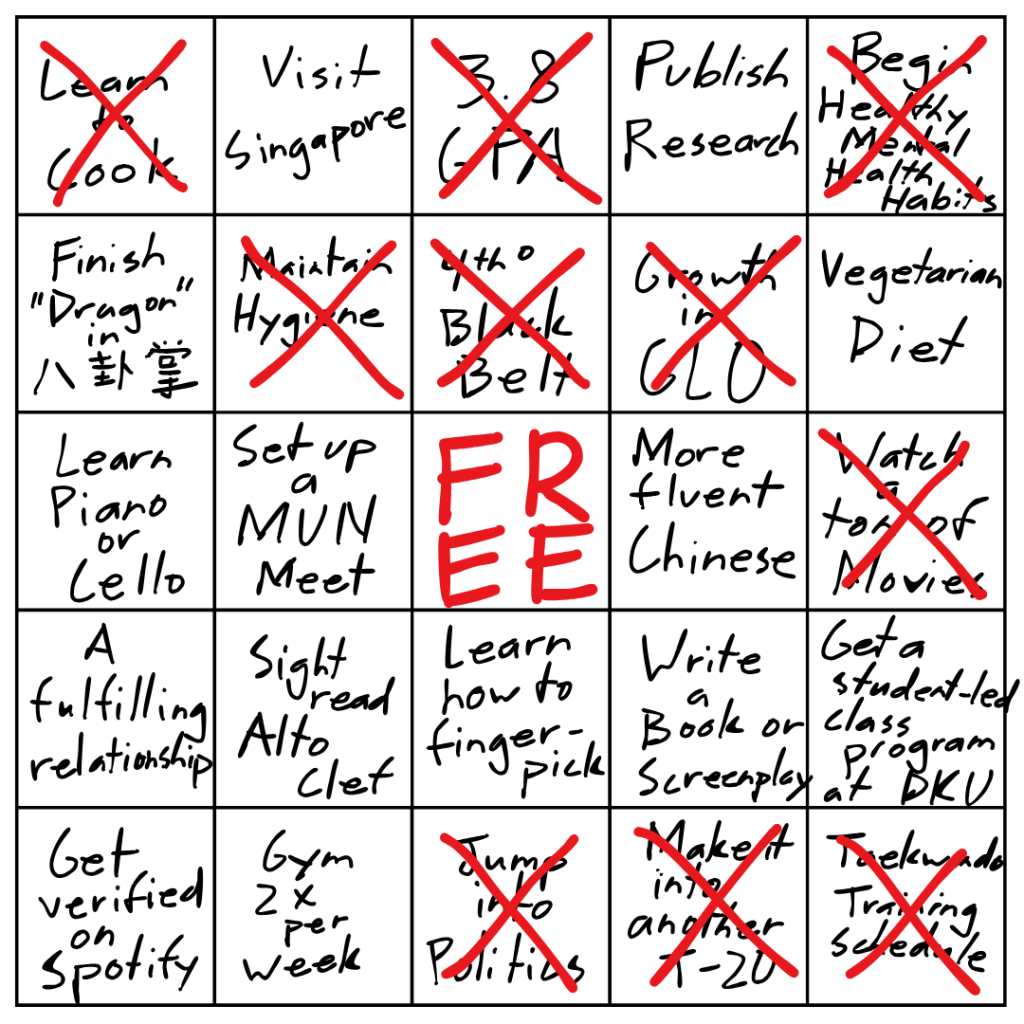
I didn’t get a BINGO. Still, I can’t say that I haven’t grown exponentially in the past year, nor can I say I didn’t accomplish my goals (10 squares is pretty good). And as the year progressed, my goals changed. So while I didn’t get research published or learn to sightread alto clef, I ended up building a website and really jumping into politics. In some ways I did get BINGO, even without that sweet five-in-a-row.
2025
Below is my 2025 BINGO card. I hope you make one alongside mine, with goals fit just right for you. Cheers to a new year and let’s work on ending it with a BINGO.

 KS Consulting
Leave a comment