


Reapplying for college means that I’ve not only been thrown back into the Common Application, but a dozen other scholarship questionnaires as well. If there is anything that gives me hope for the world, it’s scholarship. In a capitalistic society that continuously battles itself on the merits of wealth redistribution, taxation, and government-funded wellness programs, it’s quite fascinating that scholarships have broken the mold as an accepted form of altruistic give-back. Not only has it been accepted in mainstream culture, but it’s now an active process that companies strive to expand. That’s pretty amazing.
Make no mistake, scholarship is a form of wealth redistribution, and is thus anti-capitalistic-esque in nature. Only, its adoption into company culture shows a prime example where both the economic and political worlds have actively chosen to sacrifice the present to invest in the future. And this culture has expanded so far that there are more scholarships than ever before, and likely more dollars in scholarships than there are students in the US. As both my brother and I continue our hunt for college funds, two precepts have become apparent:
- There is a scholarship for just about anything, and
- There is always another scholarship to apply to.
You Don’t Have to be Scholarly to Get a Scholarship
If you think you’re never going to get a scholarship, it isn’t because of availability. Scholarship applications are the ultimate test of student willpower; they’re hard to come by but easy to find for those who actively seek them. This means that they require focused effort.
When I write that scholarships are always available, I mean it to the fullest possible extent. There is a scholarship for anything you can imagine. A quick Google search for “Cooking Scholarships” and thousands of culinary scholarships pop up, from the Vegetarian Resource Group College’s $10,000 to the WRA Education Foundation Scholarship in Culinary & Hospitality (exclusive for my Wisconsinites). A search for “Woodworking Scholarships” gives results for the National Association of Women in Construction, who gives out $100,000 every year. Heck, U.S. News & World Report has a page specifically for scholarships in woodworking. I’ve tried Google searches for just about every conceivable topic (from podcast scholarships to sleep scholarships) and there is always another lump sum of money that pops up.
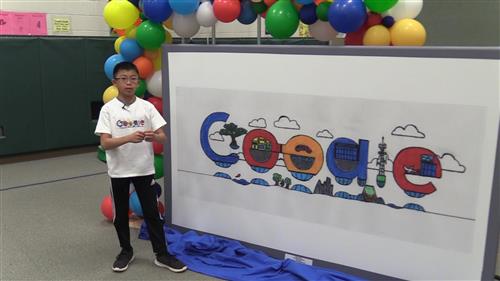
Speaking of Google searches, Google is no stranger to their own forms of unique scholarships. Its Generation Google Scholarship series has a specific pool for women in computer science in Ireland, and its Doodle 4 Google competition provides artists with Google merchandise, school funding, and technology. In fact, my brother won the 2019 Doodle 4 Google competition for the state of Colorado (fun fact: his design was voted to win by both Jimmy Fallon and Kermit the Frog). Google came to his elementary school and held an assembly. I left school early that day and hid in a gym room with our family to surprise him. A banner of his Google design still hangs at that elementary school, and my grandpa still wears his red “Google” shirt gifted on that day.
Scholarships are endlessly available because money is endlessly available, so long as you’re willing to put in the work and write whatever necessary essays there are. The failure of not receiving a scholarship is often on the student’s lack of time to apply, or lack of willpower to look.
“Scholar” isn’t Something You Earn, It’s Something You Become
That brings me to the second precept: if there are an infinite number of scholarships, then earning scholarship isn’t a matter of “doing”, it’s a matter of “doing consistently”; there is always another scholarship to apply to.
In my own personal scholarship journey, I failed to recognize the sheer breadth of available opportunities there were. However, I made up for this by being consistent in my applications; I essentially never stopped applying. The scholarships that I went for were all nationally or internationally recognized, making the chances of winning increasingly slim. Nonetheless, I applied to dozens anyway, often not waiting for the results of one before jumping into another. This also meant that the work was rather strenuous; the essays quickly stacked up by the handful. I started with the Coca-Cola Scholarship, which gives 150 students $20,000 each, and later moved on to the National Honor Society Scholarship, the Doodle 4 Google (as previously mentioned), the Boettcher Scholarship, the GE-Reagan Foundation Scholarship . . . the list goes on.
Despite a failure to apply locally, I was rewarded by my consistency, receiving semi-finalist in the Coca-Cola Scholarship and finalist for the Boettcher Scholarship. My big break came with the H.U. Lee Foundation, a national scholarship for taekwondo practitioners. Once more, there’s a scholarship for just about anything, and the best way to take advantage of this fact is through consistent effort.
Scholars
The textbook definition of a scholar is simply an individual who attends school. As such, the term “scholar” should really be less of a phrase used to differentiate the educated elite, and more of a reminder that everyone has the capabilities to learn, grow, and be recognized for their contributions. And that everyone can apply for scholarships.
Funnily enough, scholarship may be the only example of something where businesses have actually met and surpassed the expectations of their consumer base. In a world built with a business-culture of “give”, the barrier is now who is willing to jump in to “take”. Luckily, the options have been left open, and any student can join in the fray and earn their slice of the pie, so long as they’re “scholarly”: open, determined, and willing to try.
I encourage you to apply for your own scholarships, and to put in good effort in your searches and applications. Now, it’s my turn to once more do the same.
Hey Google, search “transfer scholarships”.
 KS Consulting
Leave a comment